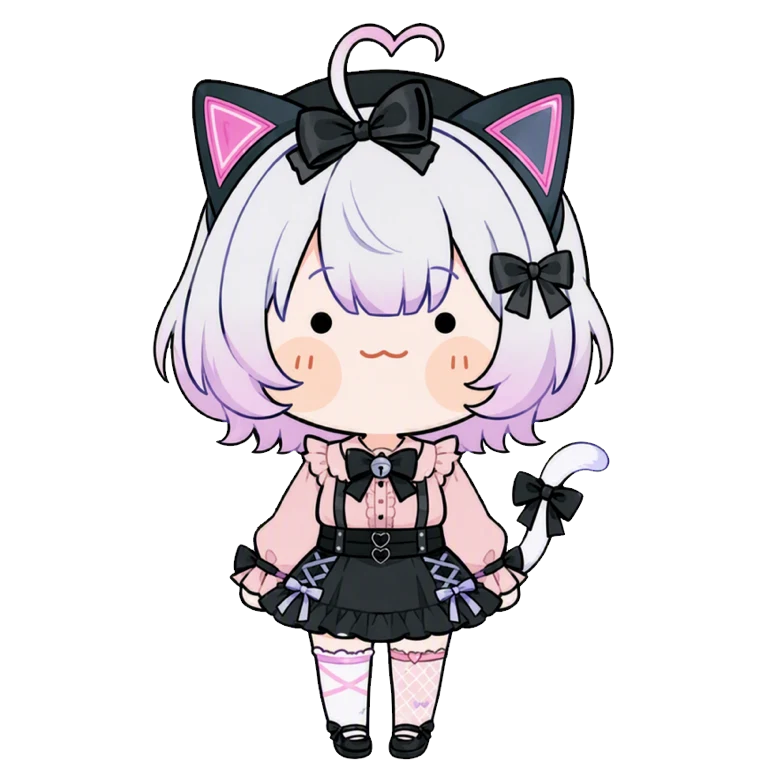


Prodigal Sun
Cheshire_Cat, cat ears, animal ear fluff, striped tail, cat tail, fur, body fur, multicolored fur, claws, curly hair, curled hair, multicolored hair, two-tone hair, pink hair, purple hair, pink eyes, ringed eyes, furry, cartoongrin, toothy-grin, fur throughout body, cat nose, striped outfit, argyle fur trim, no shoes
The first known appearance of the expression in literature is in the 18th century, in Francis Grose's A Classical Dictionary of the Vulgar Tongue, Second, Corrected and Enlarged Edition (1788), which contains the following entry: Cheshire cat. He grins like a Cheshire cat; said of any one who shows his teeth and gums in laughing. The phrase appears again in print in John Wolcot's pseudonymous Peter Pindar's Pair of Lyric Epistles (1792): "Lo, like a Cheshire cat our court will grin." The phrase also appears in print in William Makepeace Thackeray's novel The Newcomes (1855):[2] "That woman grins like a Cheshire cat." There are numerous theories about the origin of the phrase "grinning like a Cheshire Cat" in English history. A possible origin of the phrase is one favoured by the people of Cheshire, a county in England which boasts numerous dairy farms; hence the cats grin because of the abundance of milk and cream.[3] In 1853, Samuel Maunder offered this explanation: This phrase owes its origin to the unhappy attempts of a sign painter of that country to represent a lion rampant, which was the crest of an influential family, on the sign-boards of many of the inns. The resemblance of these lions to cats caused them to be generally called by the more ignoble name. A similar case is to be found in the village of Charlton, between Pewsey and Devizes, Wiltshire. A public-house by the roadside is commonly known by the name of The Cat at Charlton. The sign of the house was originally a lion or tiger, or some such animal, the crest of the family of Sir Edward Poore.[4] According to Brewer's Dictionary (1870), "The phrase has never been satisfactorily accounted for, but it has been said that cheese was formerly sold in Cheshire moulded like a cat that looked as though it was grinning".[b] The cheese was cut from the tail end, so that the last part eaten was the head of the smiling cat.[5] A later edition of Brewer's adds another possible explanation, similar to Maunder's, that a painter in Cheshire once used to paint grinning lions on inns.[2] The dictionary does not expand further on this, its editors possibly considering the connection between cats and lions self-explanatory or obvious. A 2015 article published in the Cheshire History journal examined these suggested origins, along with numerous others seen on the internet.[6] The author, Peter Young, considered most to be "inventive" but unlikely. In his analysis, the essential feature of any actual historical explanation would be one that demonstrated its innate connection to Cheshire: An idiom that retained the localism while spreading nationwide, would, in his view, need to be strongly connected to the county, in the minds of people elsewhere. For this reason, he favours the well-fed farm cats of Cheshire's dairying environment—a widely-known and well-promoted idea at the time the phrase arose—as the best candidate for the origin of the Cheshire Cat idiom. Lewis Carroll's character The Cheshire Cat is now largely identified with the character of the same name in Lewis Carroll's 1865 novel Alice's Adventures in Wonderland. Alice first encounters the Cheshire Cat at the Duchess's house in her kitchen, and later on the branches of a tree, where he appears and disappears at will, and engages Alice in amusing but sometimes perplexing conversation. The cat sometimes raises philosophical points that annoy or baffle Alice; but appears to cheer her when he appears suddenly at the Queen of Hearts' croquet field; and when sentenced to death, baffles everyone by having made his head appear without his body, sparking a debate between the executioner and the King and Queen of Hearts about whether a disembodied head can indeed be beheaded. At one point, the cat disappears gradually until nothing is left but his grin, prompting Alice to remark that "she has often seen a cat without a grin but never a grin without a cat".
